Turn your AI Act glossary spreadsheet into controlled vocabulary evidence
Legal teams are already preparing AI Act evidence in spreadsheets, Confluence pages, and policy drafts. The risk is not that the glossary exists. The risk is that nobody can prove which definition was approved, who reviewed it, when it changed, and where the wrong synonym still appears.
Why this page exists
Searches like AI Act glossary spreadsheet, AI Act terminology management, legal glossary Confluence, and controlled vocabulary AI Act point to the same job: legal wants a defensible vocabulary layer before policies, AI inventories, vendor reviews, technical documentation, and board materials start using AI Act terms inconsistently.
Current AI Act timing for glossary work
The dates below are implementation planning dates, not a substitute for counsel checking the final applicable text. They are included because timeline claims on AI Act pages changed after the AI Omnibus political agreement.
- 2 February 2025
Prohibited AI practices and AI literacy obligations applied. - 2 August 2025
GPAI model obligations became applicable. - 2 August 2026
Most AI Act provisions are still described by Parliament as starting on this date, and Commission enforcement powers for GPAI model providers remain a key checkpoint. - 2 December 2026
Parliament's 16 June 2026 Omnibus approval delays watermarking/marking obligations for AI-generated content to this date, pending formal Council adoption. - 2 December 2027
Planning date for stand-alone high-risk AI systems under the 7 May 2026 AI Omnibus political agreement. - 2 August 2028
Planning date for high-risk AI systems embedded in regulated products under the same political agreement.
Where AI Act glossary spreadsheets break
| Spreadsheet field | What goes wrong | Controlled vocabulary evidence |
|---|---|---|
| Term | Teams invent near-synonyms such as AI developer, model owner, AI tool, or user. | Approved term with allowed synonyms and deprecated synonyms. |
| Definition | Copied wording drifts between legal memo, policy page, inventory form, and vendor checklist. | One approved definition, versioned and linked to the source. |
| Owner | No clear reviewer when product, privacy, security, and legal disagree. | Named owner plus independent reviewer and approval timestamp. |
| Status | Draft, reviewed, approved, and deprecated terms sit in the same sheet without enforcement. | Lifecycle status with blocked status jumps and audit trail. |
| Usage notes | Teams cannot tell where an old term is still used. | Confluence scanner findings grouped by page and term. |
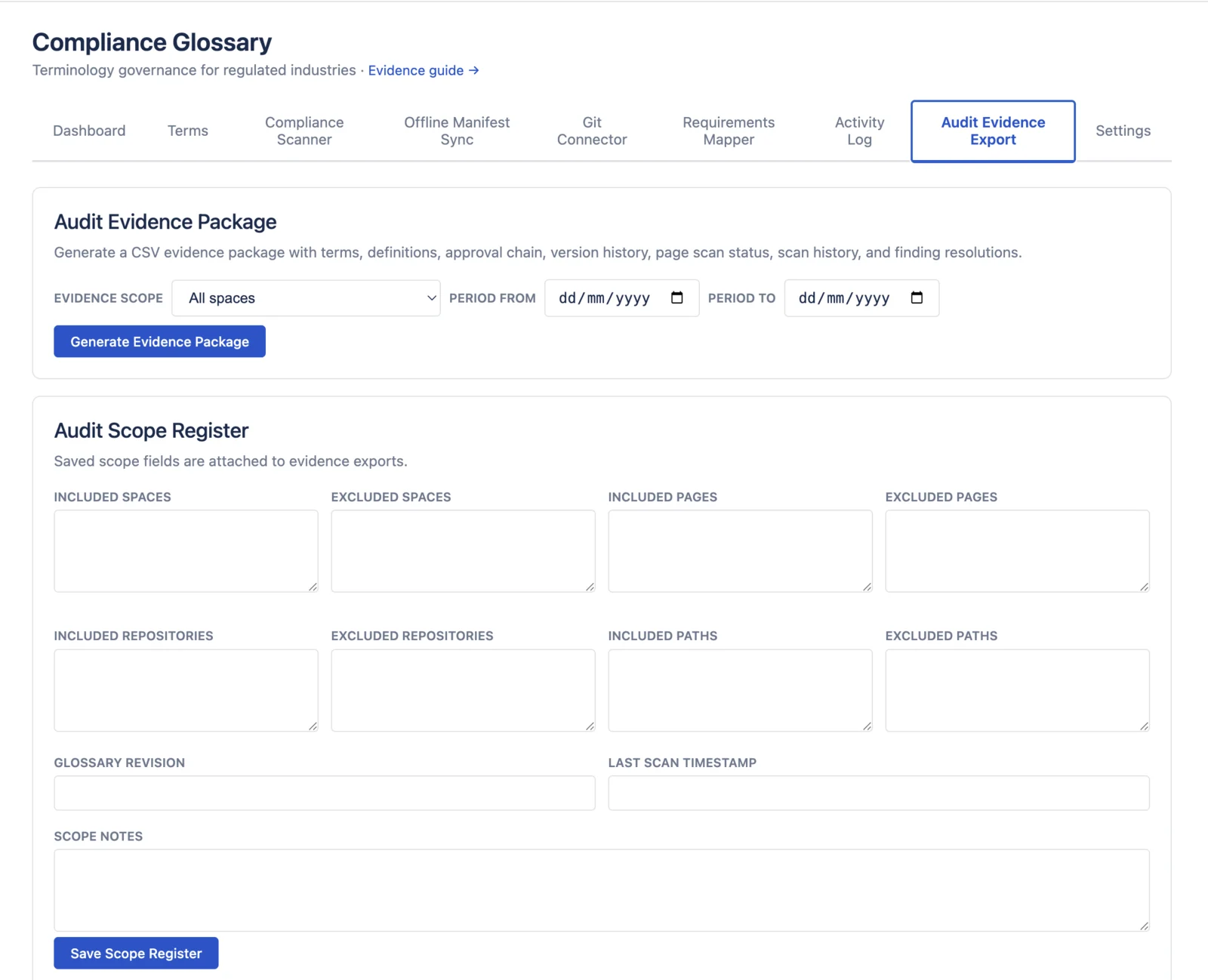
| Export | Evidence has to be reconstructed manually before an audit or board review. | CSV export with definitions, approval metadata, versions, and history. |
A 10-minute terminology evidence check
- Pick five AI Act terms your teams already use: AI system, provider, deployer, high-risk AI system, general-purpose AI model.
- Find those terms in your AI inventory, AI policy, vendor intake form, DPIA or FRIA workflow, and Confluence knowledge base.
- Check whether each page uses the same legal definition, the same approved synonym, and the same role label.
- Ask who approved the wording and whether the approval history is exportable.
- List every page that still uses a deprecated synonym or an unapproved draft definition.
If step 4 or 5 requires manual reconstruction, the glossary is not yet an evidence system.
How Compliance Glossary fits
Compliance Glossary does not decide whether a system is high-risk, write legal advice, or replace an AI governance program. It manages the vocabulary layer inside Confluence:
Approve terms
Route Article 3 definitions and internal usage notes through four-eyes review.
Track versions
Keep each definition, reviewer, timestamp, and change reason in the record.
Scan Confluence
Find deprecated or unapproved terms in policies, AI inventories, vendor pages, and board packs.
Export evidence
Export CSV evidence for counsel, audit committees, vendor review, or regulatory-change work.
Related legal reading
Compliance for Confluence
Approved terms, page scanning, and audit evidence for legal teams in Confluence.
EU AI Act glossary
Article 3 definitions, source links, and the AI Act timeline caveat.
AI Act terminology governance
How Article 3 terminology supports transparency, GPAI, and high-risk readiness.
AI policy glossary in Confluence
Legal-ops workflow for policy vocabulary and source-backed definitions.
AI use-case intake terms
Legal intake vocabulary for AI inventories and governance triage.
AI vendor due diligence glossary
Procurement and legal terminology for vendor review.
Legal article hub
The published legal/lawyer article cluster.
Operationalize the glossary
Start with the AI Act CSV template, import it into Compliance Glossary, set legal as owner, route review, scan your Confluence spaces, and export the evidence before the next board, vendor, or regulatory-change review.